Bayesian Physics-Informed Neural Networks for Parameter Inference and Uncertainty Quantification in Reaction-Diffusion Models of Wound Healing

Koshik Debanath†, Sagor Aich, Azmain Yakin Srizon
Department of Computer Science & Engineering,
Rajshahi University of Engineering & Technology, Bangladesh

†Corresponding author
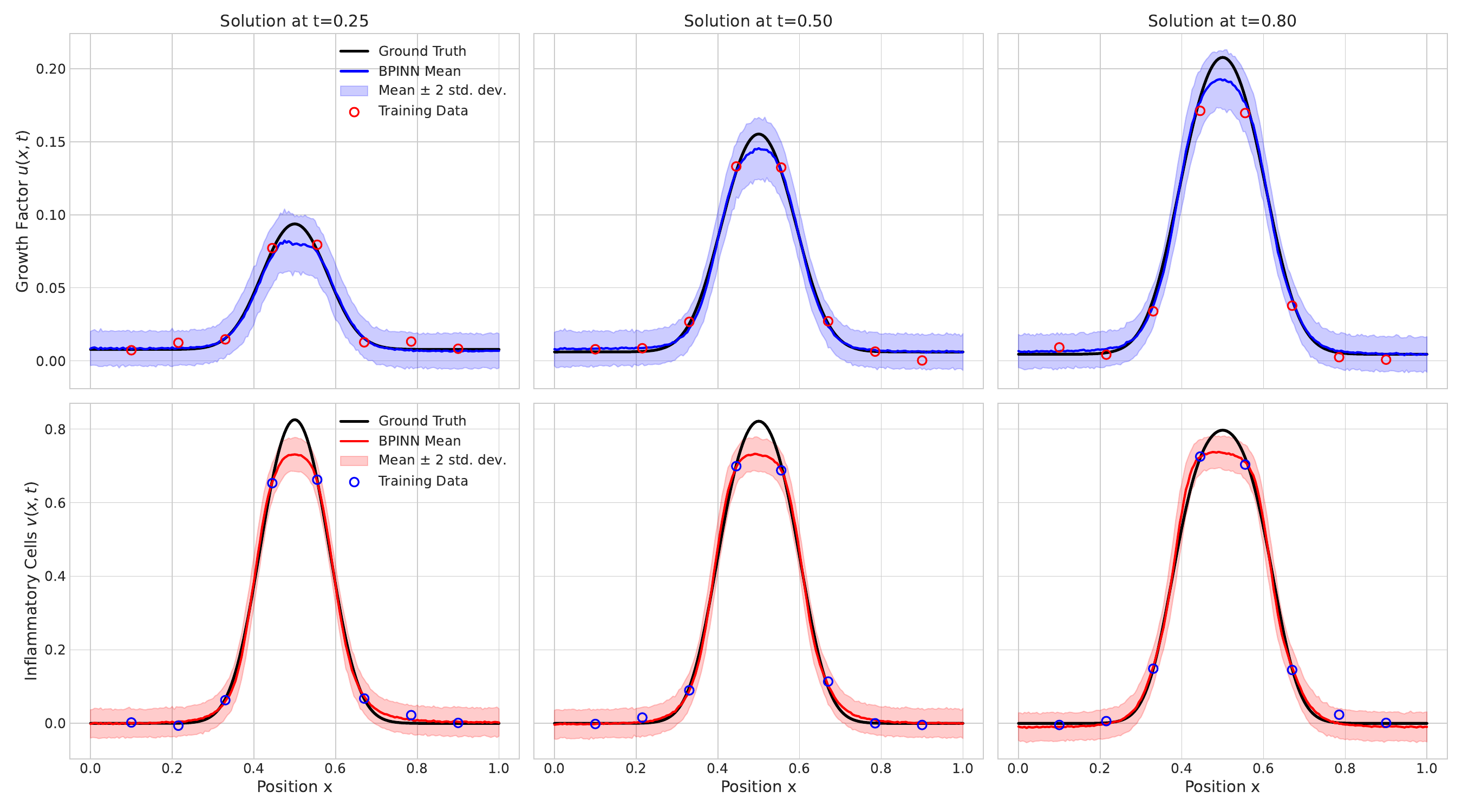
BPINN mean predictions with 95% credible intervals against ground truth at three time snapshots

From fewer than 0.01% of the spatio-temporal domain, the BPINN reconstructs the full wound-healing dynamics and reports where it is unsure. The 95% credible bands contain the true solution.

Abstract

Reaction-diffusion models governed by partial differential equations (PDEs) are essential for understanding the spatio-temporal dynamics of biological processes like wound healing. However, the clinical and predictive power of these models is often limited by uncertainty in their biophysical parameters, which are difficult to measure directly. This paper introduces a Bayesian Physics-Informed Neural Network (BPINN) framework to address this challenge by performing robust parameter inference and principled uncertainty quantification. We formulate the problem of identifying unknown parameters in a coupled reaction-diffusion system for wound healing as a Bayesian inverse problem. By integrating sparse, noisy observational data with the governing physical laws within a variational inference framework enhanced by Monte Carlo dropout, the BPINN learns the full posterior distributions of the unknown model parameters. We demonstrate that the framework can successfully infer key reaction parameters with high accuracy from a dataset comprising less than 0.01% of the full spatio-temporal domain. Crucially, the BPINN also correctly identifies that the cell motility parameter is practically non-identifiable from the sparse data, a conclusion supported by the large posterior uncertainty it assigns to this parameter. The model's predictive uncertainty is shown to be well-calibrated, being highest in regions far from observational data. This work establishes the dual value of BPINNs as a powerful computational tool: both for developing reliable and personalized biomechanical models through data-driven calibration, and for diagnosing parameter identifiability issues, a critical step towards building trustworthy models in computational medicine.

Highlights

  • A Bayesian PINN framework with MC Dropout is developed for inverse modeling of a wound healing PDE system.
  • The method infers posterior distributions of unknown biophysical parameters from sparse, noisy data.
  • Key reaction parameters are inferred with high accuracy, while the non-identifiability of the diffusion parameter is correctly diagnosed.
  • The framework provides principled, well-calibrated uncertainty quantification for both parameters and model predictions.
  • BPINNs serve both as solvers and as diagnostic tools for model validation.

Method

Wound-healing reaction-diffusion model

We model a growth factor concentration $u(x,t)$ and an inflammatory cell density $v(x,t)$ on $(x,t)\in[0,1]\times[0,1]$:

$$\frac{\partial u}{\partial t} - D_u \frac{\partial^2 u}{\partial x^2} - k_{pro,u}\, v + k_{deg,u}\, u = 0$$ $$\frac{\partial v}{\partial t} - \mathbf{D_v} \frac{\partial^2 v}{\partial x^2} - \mathbf{k_{pro,v}}\, v\left(1 - \frac{v}{V_{max}}\right) + \mathbf{k_{clear,v}}\, u v = 0$$

with $u(x,0)=0.01$, $v(x,0)=0.8\exp\!\left(-(x-0.5)^2/0.1^2\right)$ and zero-flux (Neumann) boundaries. The inverse problem: infer the posterior over $\boldsymbol{\theta}=\{D_v, k_{pro,v}, k_{clear,v}\}$ from sparse, noisy measurements $\mathcal{D}=\{(x_i,t_i,u_i,v_i)\}_{i=1}^{N_{data}}$.

Bayesian PINN

A tanh feed-forward network $\mathcal{N}_{\boldsymbol{\phi}}:(x,t)\mapsto(\hat u,\hat v)$ with dropout after every activation captures model uncertainty (MC Dropout). Each unknown parameter gets a Gaussian variational posterior $q_{\boldsymbol{\lambda}}(\boldsymbol{\theta})$. A fresh sample $\boldsymbol{\theta}_s\sim q_{\boldsymbol{\lambda}}$ is drawn on every forward pass to evaluate the PDE residuals. Training minimizes the negative ELBO:

$$\mathcal{L}_{\text{total}} = \underbrace{w_{data}\mathcal{L}_{\text{data}} + w_{ic}\mathcal{L}_{\text{ic}} + w_{bc}\mathcal{L}_{\text{bc}} + w_{pde}\,\mathbb{E}_{\boldsymbol{\theta}_s\sim q_{\boldsymbol{\lambda}}}\!\left[\mathcal{L}_{\text{pde}}(\boldsymbol{\theta}_s)\right]}_{\mathcal{L}_{\text{recon}}} + \beta\, D_{KL}\!\left(q_{\boldsymbol{\lambda}}(\boldsymbol{\theta})\,\|\,p(\boldsymbol{\theta})\right)$$

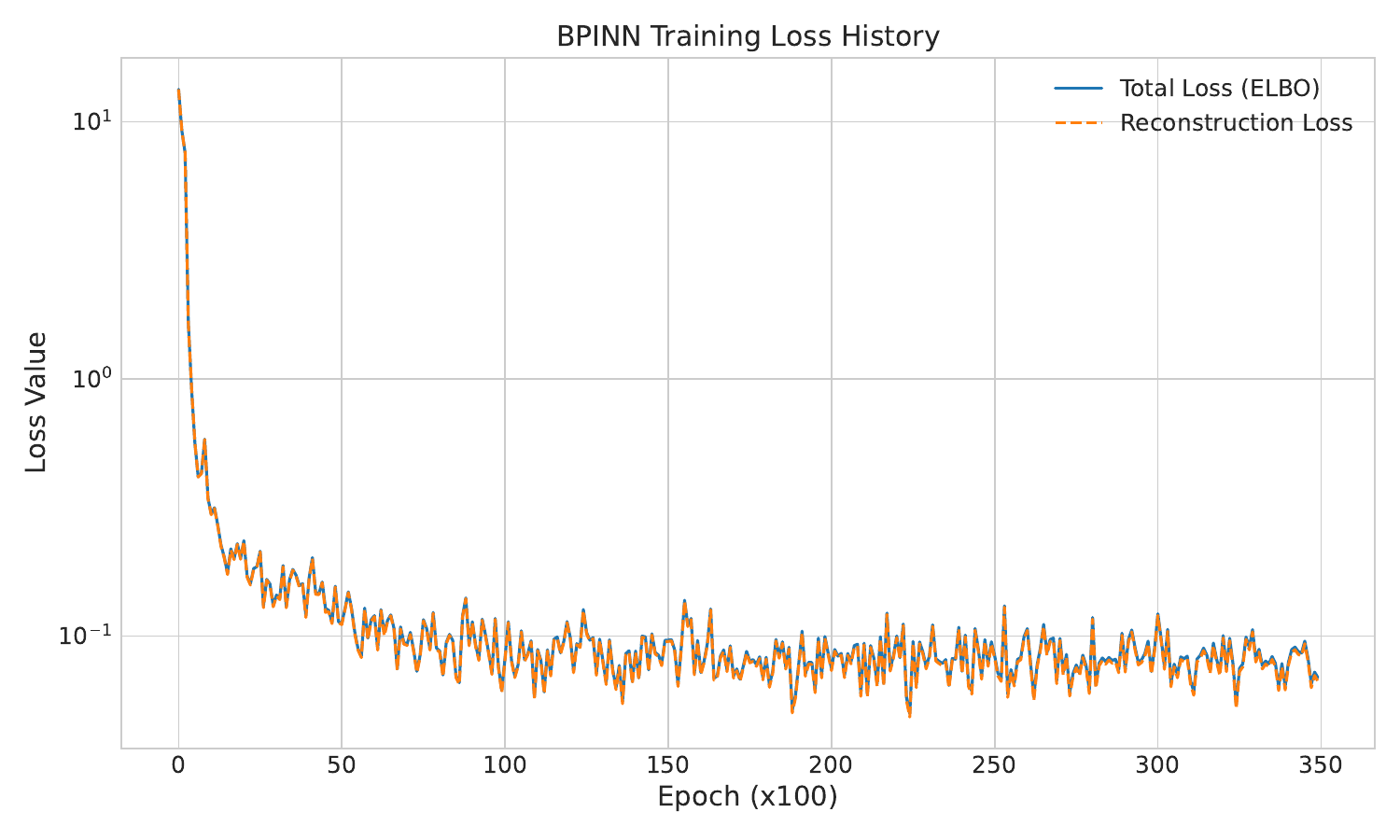
We use weights $\{w_{data}, w_{ic}, w_{bc}, w_{pde}\} = \{100, 10, 10, 1\}$, ramp $\beta$ linearly from $0$ to $10^{-6}$, and train for 35,000 epochs with Adam in PyTorch.
Inputs (x, t) FNN 𝒩φ tanh activations + MC Dropout (û, v̂) PDE residuals fu, fv (autodiff) θs ~ qλ(θ) Dv, kpro,v, kclear,v Sparse data 𝒟 Data loss ℒdata IC / BC loss ℒic,bc PDE loss ℒpde β · KL(qλ ‖ p) + ℒtotal Adam: update network weights φ and variational parameters λ

BPINN framework. The network maps $(x,t)$ to $(\hat u,\hat v)$. Predictions are matched to sparse data and to the initial/boundary conditions. PDE residuals are computed by automatic differentiation using parameters sampled from their learned distributions $q_{\boldsymbol{\lambda}}$, and a KL term regularizes those distributions toward the prior. The optimizer updates both $\boldsymbol{\phi}$ and $\boldsymbol{\lambda}$.

Results

Parameter inference and identifiability

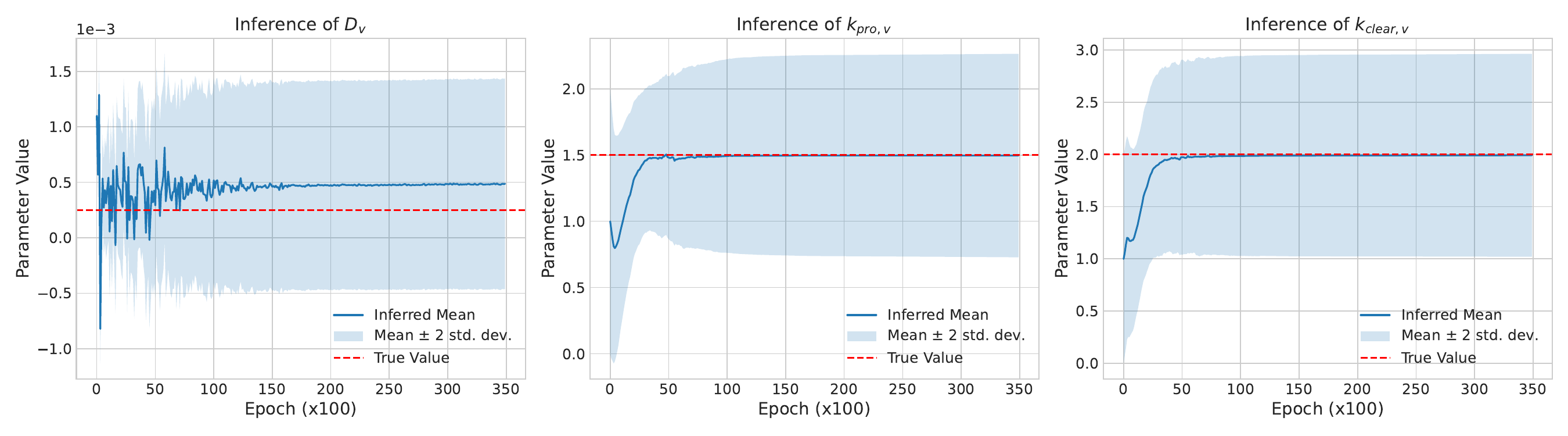
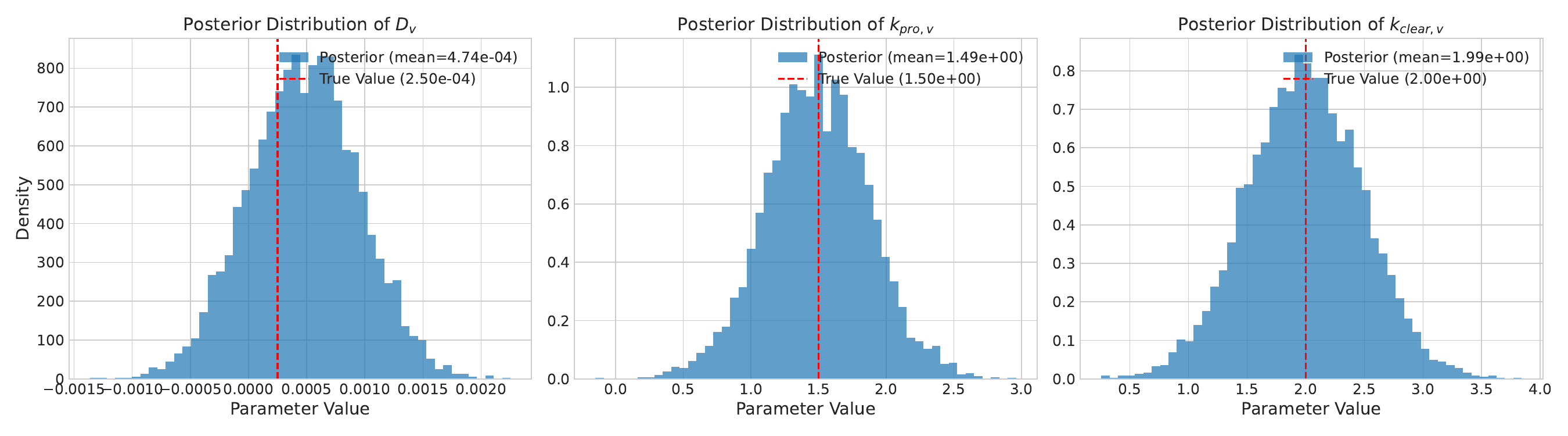
The reaction parameters are recovered with high accuracy and tight posteriors. The cell motility $D_v$ gets a very wide posterior. This is not a failure. The BPINN correctly flags $D_v$ as practically non-identifiable from the sparse data, because its effect is masked by the stronger reaction dynamics.

ParameterTrue valueInferred meanPosterior
$k_{pro,v}$ (proliferation)1.5001.496Sharp, identified
$k_{clear,v}$ (clearance)2.0001.992Sharp, identified
$D_v$ (cell motility)$2.50\times10^{-4}$$4.78\times10^{-4}$Wide, non-identifiable
Evolution of inferred parameter means and 95% credible intervals during training

Evolution of the inferred posteriors during training (mean and 95% credible interval). $k_{pro,v}$ and $k_{clear,v}$ converge to their true values; $D_v$ keeps a large uncertainty.

Final posterior histograms for the three unknown parameters

Final learned posterior distributions. The reaction parameters are sharply centered on the truth; the wide $D_v$ posterior reflects honest uncertainty.

Solution reconstruction and uncertainty

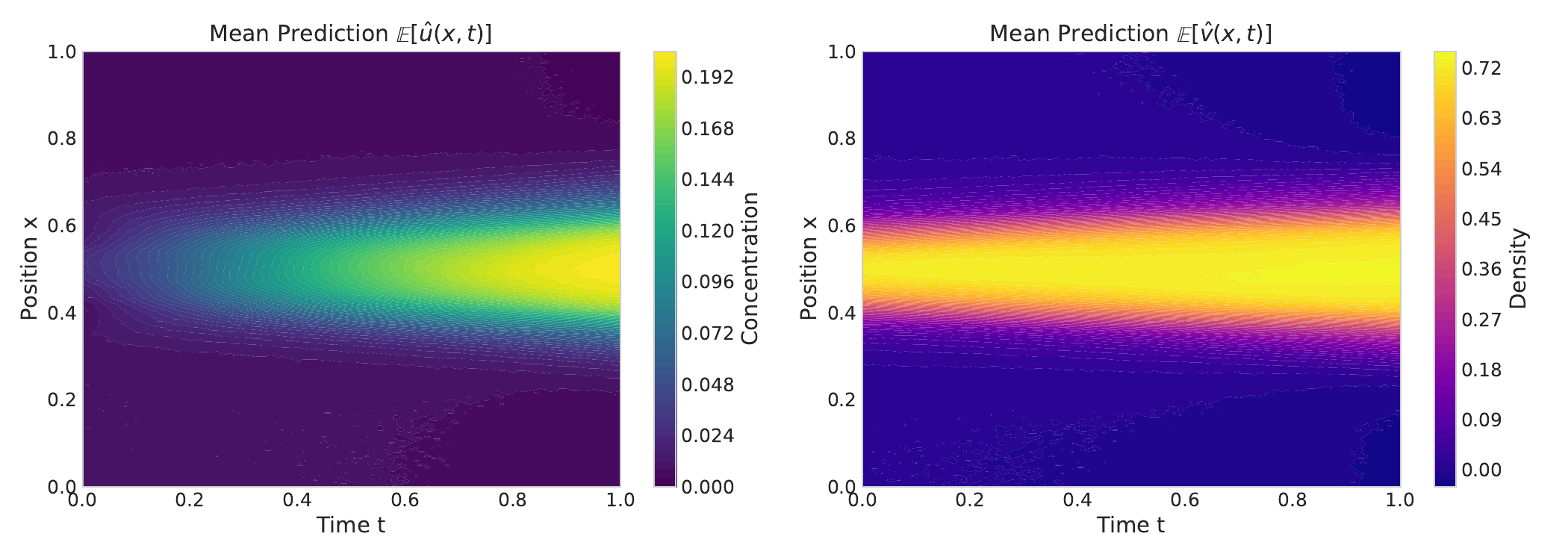
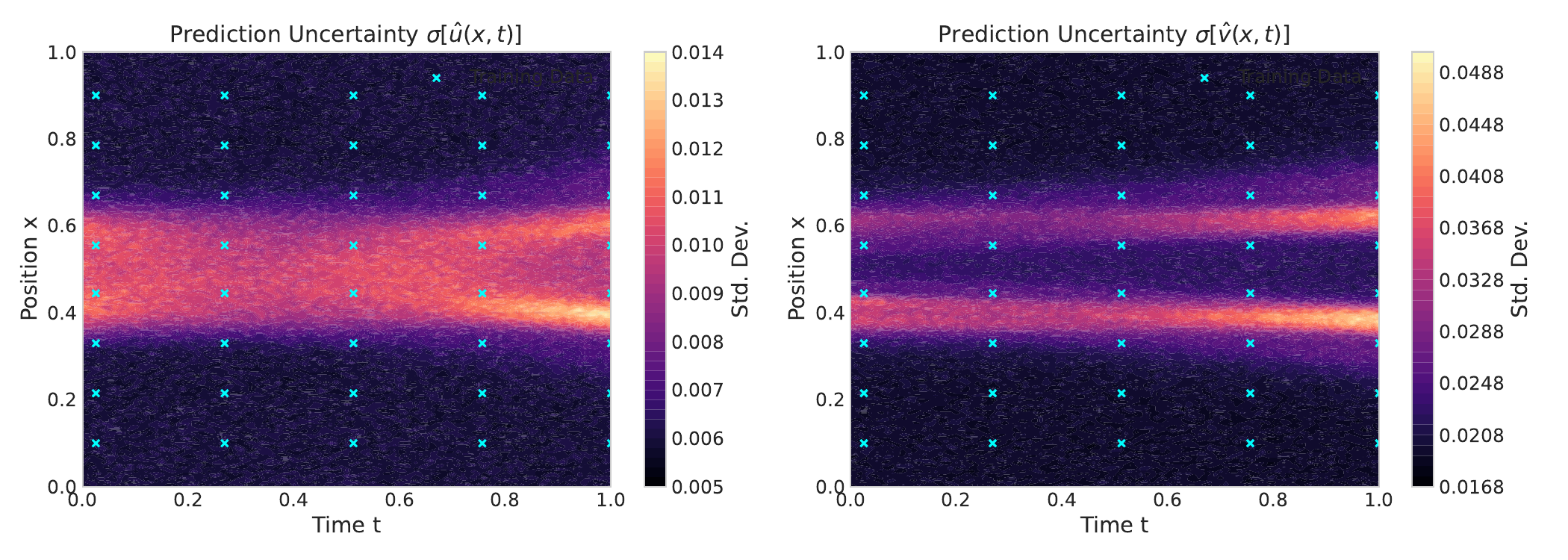
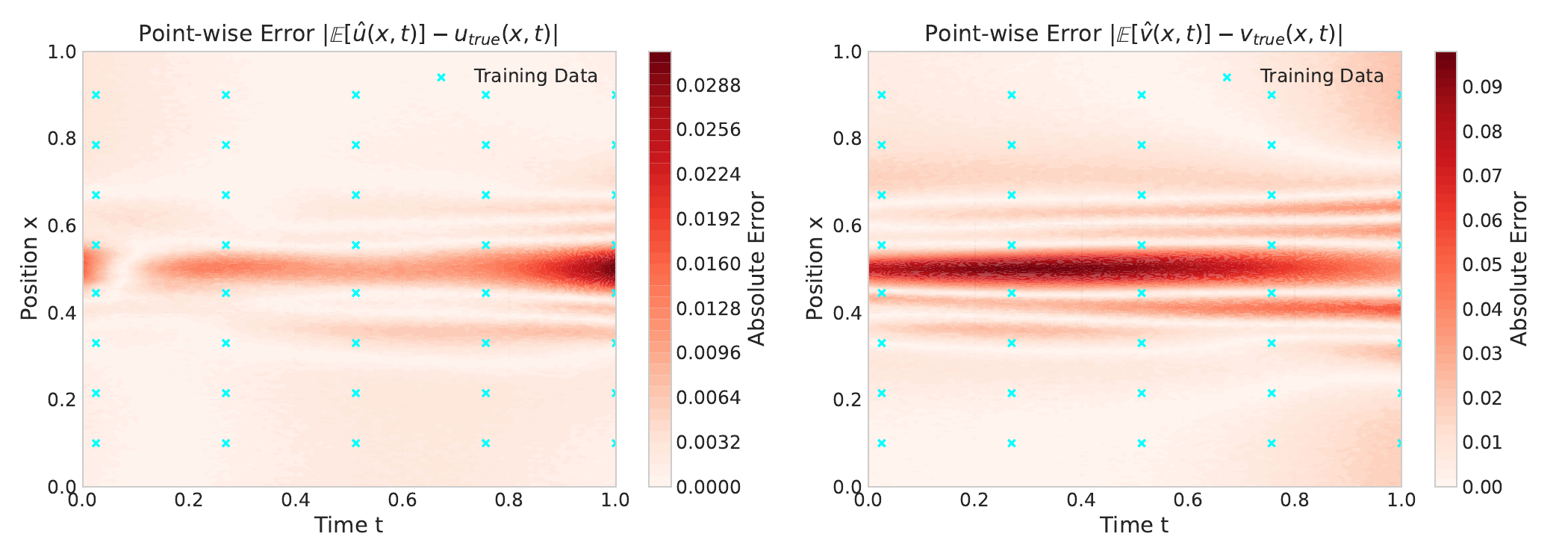
The mean fields match the ground-truth dynamics. Predictive uncertainty is lowest near the training data and grows in data-sparse regions, and the regions of highest error line up with the regions of highest reported uncertainty: the UQ is well calibrated.

Paper

BibTeX

@article{debanath2025bpinn,
  title   = {Bayesian Physics-Informed Neural Networks for Parameter Inference and
             Uncertainty Quantification in Reaction-Diffusion Models of Wound Healing},
  author  = {Debanath, Koshik and Aich, Sagor and Srizon, Azmain Yakin},
  journal = {Manuscript submitted to Journal of Computational Physics},
  year    = {2025}
}